I would like to wish all my readers, followers and casual browsers a very Merry Christmas & Happy New Year. I look forward to bringing you more reviews, memorabilia, walkthroughs and of course lots of car show photos in the coming year.
My little ol’ blog has been evolving into a ‘blogsite’ over the last couple of years with my stats telling me that I’m approaching a truly amazing 1,550,000 views, which I never believed would be possible. I fund this blogsite all by myself with a small contribution from the WordPress adds (sorry) now and then which contributes to the hosting fees, registration and everything else (but doesn’t cover it all) that goes with an online presence. I can only say a huge and sincere “Thank You” to everyone for keeping me encouraged to continue and making this all worth while.
Merry Christmas & Happy New Year, see you all in 2026.
After some twelve plus years I now have an issue with my most trusted TomTom Go 600, the battery has died. You may be asking why am I bothered as Google Maps is available phones, updated regularly and works, some consider it better than many dedicated SatNavs, TomTom or Garmin to name just a couple. Even my daily driver has an up-to-date SatNav which I use, a lot. This TomTom Go 600 is used in my Mustang and sits on the centre console in a weighted mount setup. I need guidance to virtually any location where I can’t see my own house. I honestly get lost anywhere, even somewhere that I’ve been before, often a standing joke with friends and family. I prefer to use the TomTom instead of the phone with google maps and the smart watch on my wrist for turn by turn notifications which is great, but the phones battery gets drained before I even get to the location. At car shows most of the phones battery is used up with the camera usage and then a little bit of reading while sitting in my chair. I often take a backup charger with me just in case I need to charge the phone, but it’s a pain. It’s often easier to plonk the SatNav on the console, plug it in so there is no battery worry on the phone. Besides, the screen is bigger on the TomTom and the sound is louder for directions.
On this device the battery lasts about one hour when not plugged in, or I can’t be bothered to plug into the cigarette lighter for the shorter trips. The battery no longer holds a charge of any sort, often to the point that even with power from the cigarette lighter, it can’t hold the power so the unit has shut off on me a few of times. Without external power, the device hardly has enough power to show the empty battery symbol and just dies, not even a proper shut down.
After a quick bit of research I found video on YouTube as a tutorial on how to change the battery, it was worth a go. Why go to the bother, just get an up-to-date model? I certainly could upgrade, however this model has free map updates for life! After twelve years, every few months I get a map update. This device owes me nothing, so a replacement battery and some cheap tools from Amazon £20 all in, would be worth a go. The battery arrived the next day along with the tools needed to take these sort of devices apart. I also needed a pen knife, a blunt one which is sometimes used to open packages etc.
Disclaimer: If you attempt this repair, it’s of your own choice and I won’t be held responsible for any damage or loss.
My experience of the practical wasn’t so easy as the video suggested, so I thought I would document what I did to fix it. I don’t know if the models are designed differently after a while, but my internals were a little different to the YouTube video even though it was the same model designation.
The first step was to separate the two halves of the device, this is where the plastic tools came in, well to start with anyway.
The two parts we so well together I had to get the penknife to get between the two halves and lever them apart. As I worked my way round I used triangular picks in various place to stop the device snapping back together again. There are no screws that hold the two halves together. As the device separated I heard a couple of little snaps where the plastic catches has snapped below right. I was not brutal in fact rather careful, perhaps the plastic is getting brittle with age. The face has a little piece of tape which holds the screen ribbon in place just before the connector itself to the main motherboard.
With the screen out of the way the plastic flat ribbon needs to be eased out of the connector by moving the white clamp towards the ribbon which will release the pressure on the clamp and allow the cable to be pulled out.
The two halves are now fully separated, put the screen to one side out of harms way. The below image shows one of the additional sprung connections at the tip of the screw driver. These are delicate and transfer the touch inputs of the screen to the main board. Hence the flat metal plate that is on the back of the screen.
Next we need to disconnect the speaker and the battery connections, using the plastic tools separate the two plugs.
Get yourself a nice set of screw drivers to remove the five flat cross head screws holding the circuit board to the back case.
With the screws removed lift the top of the board, the opposite to the connections at the bottom. With the board elevated you can then slide the bottom half of the board out of the case. With the board also put out of harms way the battery is exposed at the bottom. The battery will need to be prized away from the case as it’s stuck in place with double sided tape. As with all Li-ion batteries be very very careful.
The old battery and the new one side by side. The new battery on the left has a slightly higher capacity which should retain a little longer life. the original battery is on the right.
In the box supplied with my battery was fresh double sided tape, which needs to stuck on the back to hold the battery in place. The new battery is slightly smaller but still sits neatly in the area. Make sure that the wires are near the speaker and not the opposite end or they wont be long enough to connect.
Take the circuit board and align the bottom of the board to openings. Gently lay the fish the two sets of wires through the hole in the circuit board and then lower the board down into place. Align the screw holes and lightly screw into place. This will allow you to pick the device up and make sure the connections are fully located correctly. Once you are happy with the alignment fully tighten the five screws, do not over tighten. Next re-insert the battery and the speaker cables to the back of the board.
Hold the screen near the main circuit board that will allow the flat cable to fall above the ribbon connection. I couldn’t take pictures at this point as I needed both hands. While holding the screen still gently guide the flat ribbon into the opening evenly. Do not force the ribbon or it will kink, the ribbon should just slot into place. Once the ribbon is fully inserted in place, slide the white clamp away from the ribbon to clamp the ribbon in place. Both the screen and the ribbon should now be connected. Very lightly pull the screen to make sure the ribbon does not pull out.
Lay the screen onto the case to align the two halves again. Make sure that the sprung connectors are not damaged be fully lowering the screen down. Starting at the bottom snap into place and work up the sides to the top. As you snap the case together make sure the connections at the bottom are stay correctly aligned. The broken clips were at opposite ends of the device so it didn’t prevent re-assembly of the unit.
Now turn the device on.
Now check that the screen is still touch responsive once the unit has fully started.
Once everything was working I was able to give everything a clean and full charge. The difficult part was separating the two halves without damage. The YouTube video showed it almost falling apart which wasn’t the case. The plastic tools weren’t quite man enough to separate the halves, hence the use of the pen knife for a little more robust leverage. Once apart it was pretty simple to remove the board, replace the battery and re-assemble.
Total time taken: 40 mins
Difficulty Level: 4 out 10
Conclusion: the only real difficulty was taking apart without damage and re-aligning the motherboard ports to the bottom of the case.
I have collected many books and reviewed most of them on my blogsite here. The latest addition to my book collection I stumbled on by accident and decided that I needed to check it out. The book is based on a highly debated topic; was there a 1964 1/2 or just the 1965 model of Mustang. This book goes into great detail about the the 1964 1/2, 1965 and the 1966 model Mustangs. If you thought there was no 1964 1/2 model, then this book will explain why there was in fact a first 1964 model year. The first Mustang was launched to the public 17th April 1964 at the World Trade Fair in New York, the car had to be developed and built for that launch date early 1964. The first Mustang rolling off the Dearborn plant’s production line on 9th March 1964. Along with the book below I also managed to bag myself a rare Ford issue workshop labour time book for the Ford production lines. This ‘Labor Schedule’ also proves there was a different process for some aspects of the 1964 cars compared to the 1965 and 1966, the ‘first gen’ Mustangs as they are often referred to. Each of the model years has its own time allocation. If the 1964 and the 1965 were the same then there would only be two years listed, and why would Ford go to the effort of listing three years. In fact there were also subtle differences between the 1965 and the 1966 models as well, such as the grill, dash layout, rear quarter furniture etc. But we won’t be delving into those differences here.
19641/2 Cars
March 9th 19664: Production begins at Dearborn, Michigan
July 13th 1964: Production begins at San Jose, California
July 31st 1964: Last documented build dater for 1964 1/2 cars at Dearborn and San Jose
Production totalled 121,538 units of which coupes 92,705 and Convertibles 28,833
1965 Cars
August 1st 1964: Production begins at Dearborn & San Jose
February 1st 1965: Production begins at Metuchen, New Jersey
July 31th 1965: Last documented build date for 1965 cars at Dearborn
August 13th 1965: Last documented build date for 1965 cars at Metuchen
August 20th 1965: Last documented build date for 1965 cars at San Jose
Production totalled 559,541 units of which coupes 409,260 Fastbacks 77,079 Convertibles 73,112
1966 Cars
August 16th 1965: Production begins at Dearborn and San Jose
August 25th 1965: Production begins at Metuchen
July 27th 1966: Last documented build date for 1966 cars at Metuchen
July 29th 1966: Last documented build date for 1966 cars at Dearborn
Production totalled 607,568 units of which coupes 499,751 Fastbacks 35,698 and convertibles 72,119
Although Ford never officially marketed a “1964½ Mustang.” The term was enthusiast-created to distinguish early builds. By 1965, Ford had standardized the lineup, but the nickname stuck, becoming part of Mustang lore and collector culture. Many owners don’t care, but a lot do. It’s just like owning a first edition book or a second edition.
The first book which has lots of well researched details and pictures in this excellent publication by Colin Date is called “Collector’s Originality Guide Mustang 1964 /12 to 1966“, a bit of a long title, but it explains exactly what this book is all about. This is obviously a very small niche market and will only appeal to die hard fans of the Mustang or those interested in the history and birth of the ‘Pony’ car.
Do you know where the term ‘Pony Car’ come from? After a couple of searches I found these interesting explanations.
‘The term originated in the USA in the mid-1960s which refers to a class of American automobiles that are characterized by their sporty appearance, affordable price, and the availability of a range of powertrain options. The term was popularized just after the launch of the Ford Mustang which reflects not only the mustang horse, which symbolizes speed and agility, but also emphasizes a focus on youthful energy and ‘spirited driving’.’
‘The general idea was to create a compact, affordable, and stylish platform that appealed to younger drivers. The Mustang’s success led to the emergence of similar cars, including the Chevrolet Camaro, Dodge Challenger, and Pontiac Firebird, all competing in the pony car segment.’
Onto the first book by Colin Date;
The book is now sadly out of print and the first edition hardback version being even harder to find. Some resellers are listing these books for stupid amounts of money to make a quick buck, (check out the screen shot below). You really do need to shop around and you can still pick one up at a reasonable cost from eBay., I got mine for just under £30 including Shipping. Mine has a little discolouration to the cover, but the inner pages are all excellent along with the binding.
The book lists many differences from rust protection to hub caps, from dash to fuel tanks, far to many to list here or I may just as well rewrite the book on my blogsite.
Here’s a quick list of 20 differences between the 1964½ and 1965 Ford Mustangs in no particular order;
Production timeline The 1964½ Mustangs were built between March and August 1964, while the 1965s began after August. Ford officially classified all as 1965 models, but enthusiasts coined “1964½” to distinguish early cars. This timeline difference explains why certain mechanical and styling updates only appear in later ’65 builds.
Charging system 1964½ Mustangs used a generator for electrical power, while 1965 models switched to a more efficient alternator. This change improved reliability and reduced maintenance issues, marking one of the most obvious mechanical differences between the two versions. Collectors often check this detail to confirm authenticity.
Horn placement On 1964½ cars, horns were mounted on the frame behind the radiator, while 1965 models relocated them to the engine bay apron. This subtle change simplified assembly and improved accessibility for servicing, making it a useful identification marker for restorers.
Hood design Early 1964½ Mustangs had uncrimped hoods with beveled headlamp bezels, while 1965 models featured improved crimped hoods. The change enhanced durability and reduced vibration issues, reflecting Ford’s quick response to early production feedback.
Radiator support The 1964½ radiator support included battery cooling vents, which were eliminated in 1965. This modification streamlined production and reduced unnecessary complexity, as overheating issues proved minimal in later testing.
Engine options 1964½ Mustangs offered unique engines like the 260 V8 and 289 “Hi-Po” V8, while the 1965 lineup standardized around the 200 six-cylinder and 289 V8 variants. This rationalization simplified choices and aligned with Ford’s broader performance strategy.
Fastback availability No fastback body style existed in 1964½. The fastback debuted in 1965, expanding Mustang’s appeal to performance enthusiasts and cementing its image as a sporty pony car.
Wheel size Standard wheels on 1964½ Mustangs were 13 inches, while 1965 models upgraded to 14-inch wheels. The larger wheels improved handling and ride comfort, reflecting Ford’s effort to refine driving dynamics.
Interior door locks 1964½ cars had round door lock knobs, while 1965 models switched to tapered knobs. Though minor, this change improved ergonomics and became a quick visual cue for identifying early cars.
Seat belt anchors 1964½ Mustangs lacked reinforced seat belt anchors, while 1965 models included them to meet evolving safety standards. This reflected Ford’s adaptation to regulatory pressures and consumer expectations.
Fuel pump The 1964½ used a longer fuel pump with a vacuum line for wipers, while 1965 models adopted a shorter pump with a separate wiper motor. This improved reliability and simplified maintenance.
Headlight buckets Early cars had beveled headlight buckets, while 1965 models featured smoother, standardized buckets. This change improved assembly consistency and reduced manufacturing costs.
Starter motor 1964½ Mustangs used a smaller starter motor, while 1965 models upgraded to a larger, more durable unit. The change addressed early reliability issues and improved cold-start performance.
Carburetor linkage The 1964½ featured a unique carburetor linkage setup, later revised in 1965 for smoother throttle response. This refinement reflected Ford’s commitment to improving drivability.
Hood release 1964½ cars had a different hood release mechanism, which was redesigned in 1965 for easier operation. This small but practical change improved user experience.
Brake light switch The 1964½ used a hydraulic brake light switch, while 1965 models switched to a mechanical switch. The mechanical design proved more reliable and less prone to failure.
Windshield wipers 1964½ Mustangs powered wipers via the fuel pump vacuum line, while 1965 models used a dedicated electric motor. This upgrade improved performance, especially in wet conditions.
Exhaust system Early cars had a unique exhaust routing, revised in 1965 for better clearance and reduced noise. This change reflected Ford’s quick response to customer feedback.
Heater blower motor The 1964½ Mustangs used a four‑wire heater blower motor, while the 1965 models switched to a two‑wire design. This change simplified the electrical system, reduced potential failure points, and made servicing easier. Collectors often use this wiring difference as a reliable way to distinguish early cars from later ones.
Paint Colours There were different paint options for 1964; Guardsman Blue, Skylight Blue, Cascade Green, Phoenician Yellow, Twilight Turquoise, Pagoda Green, Chantilly Beige and Pace Car White and for 1965 were Springtime Yellow, Champagne Beige, Silver Blue, Honey Gold, Tropical Turquoise, and Ivy Green.
I also have another link to the differences in a slightly different quick reference format here.
Although I mentioned that Ford never officially marketed the 1964 1/2 model, they certainly did separate them for their production lines purposes. This production line manual which I review and scanned here “Suggested Labor Time Schedules” has some interesting points. There are no diagrams or photos, just categorised production plant specific tasks and how long that particular part of the assembly should take to complete.
I have selected a few instances where the production times are different between the years or not available on the early 1964 cars such as the suspension components.
This ‘Time Schedule’ shows the various sections of the car and how long it should take to assemble.
These ‘Schedules’ were updated regularly hence the clip folder, the old sections were removed and thrown away in favour of the new updated sections sent to the production plants. These schedules were often discarded once the production lines changed to the new models to be made. Finding one is rare, let alone a complete one with some of the older sections as well as the new sections still in place. To many people this is a nothing document, but to collectors it’s a brief historical glimpse into the past. I have scanned all the 550 pages into a single PDF file here. Be warned though, it’s a big PDF download coming in at some 450mb in size.
Not only does this ‘Labor Schedule’ prove there was a difference, but it also confirms the findings of Colin Date where he has noted the differences, such as the suspension.
Conclusion:
Most of the time many Mustang owners will lump the 1964 1/2 into the 1965 model and leave it at that. But, those that are into their cars will know there is indeed a difference. The many third party books and articles that are out there document the differences (including myself), and there is this official Ford production line schedule. Either way, take it from Ford that there wasn’t an official 1964 1/2 car, or take it from Ford’s very own documentation that there was indeed a 1964 car! My own point of view is that I lean towards the latter point of view.
There are only a handful of cars that carry the same recognition and emotional pull as the Ford Mustang. Since its debut 17th April 1964 at the New York World Trade Fair, the Mustang has remained one of the most iconic cars on American roads. Its mix of performance, style and heritage has helped the brand survive changing automotive trends within a competitive market. Even today, collectors, enthusiasts, and casual drivers find reasons to admire and own these classic cars. For some, searching for a wrecked Mustang for sale or browsing junk cars for sale is a way to restore a piece of history and connect with the legend. Dry states in America as we refer to them here in the UK, still contain a treasure trove of cars that are worth restoring or even buying them just for those hard to find original parts.
A Strong Legacy
The Mustang was introduced in 1964 it quickly gained a loyal following, the demand far outweighed the supply and Ford couldn’t make them fast enough. The Mustang sales had set records that still haven’t been matched to this day. The Mustang represented freedom and individuality during a period of cultural changes taking place in America. With its long hood, endless options of engines and gearbox, short rear deck and the sporty stance, it established a design that influenced decades of vehicles or ‘Pony’ cars. Generations of drivers grew up with the Mustang, making it more than just a car, it became a cultural touchstone tied to movies, music, and motorsports.
Timeless Design
One of the key reasons for the Mustang’s enduring appeal is its design. While the car has evolved over the years, each version retains that unmistakable Mustang character. The bold grille, aggressive body lines, and muscular stance are instantly recognizable. Owners and fans often mention that the later modern Mustangs capture the essence of the originals, we won’t mention a couple of designs during the oil crisis, where styling went slightly off the rails. The blend of nostalgia, performance and modern engineering makes the car attractive to both young buyers and long-time collectors.
Performance Options
Performance has always been at the heart of the Mustang. From affordable base models to high-powered GTs, the much sought after Shelby variations and even tuners like Saleen, the Mustang offers a wide spectrum of driving experiences. V8 engines, roaring exhaust notes, track ready with the thrilling acceleration keep enthusiasts coming back for more. Even with recent moves toward more efficient engines like the Eco Boost or the controversial ‘Mustang’ Mach-E, Ford ensures that the Mustang still delivers an exciting ride while keeping the soul of the Pony car alive. This fine line balancing act between tradition and innovation strengthens its ongoing popularity for each generation of car and the generations of owners to come.
An Affordable Entry Point
Unlike some sports cars that remain out of reach for most drivers, the Mustang has always provided a good performance for your buck. Even today, buyers can get into a Mustang without the steep price tag of European competitors. Saying you own a Mustang has element of coolness to it. The affordability for base models makes it appealing to first-time sports car buyers, young drivers, and collectors alike. Many enthusiasts also find older models to restore or customize, often through salvage markets and the vast aftermarket parts available. I know of a couple of owners who have new Mustangs and maintain or are restoring a classic Mustang as well.
Strong Enthusiast Community
The Mustang community is one of the largest and most active car groups worldwide. Car clubs, forums, and events bring together owners and fans to share their passion. Annual Mustang meets and local shows showcase restored classics, modified builds, and brand-new models. This sense of belonging and shared enthusiasm helps keep the Mustang relevant across generations. Even belonging to a Mustang Owners club of some sort can get you cheaper insurance.
Pop Culture Presence
From the Mustang’s role in Bullitt, Gone in 60 Seconds (both films) to appearances in modern film and television, the Mustang has long been tied to American pop culture. Its on-screen presence reinforces the car’s image as powerful, stylish, and dare we say rebellious brand. The car’s constant visibility helps introduce the Mustang to new audiences who may not have even considered one otherwise.
Conclusion
The Ford Mustang remains popular because it is more than just a vehicle. It represents history, identity, and performance at a price that appeals to a wide range of buyers. With its strong heritage, ongoing legacy, timeless design coupled with a vibrant community, the Mustang continues to inspire. For enthusiasts, owners and daily drivers, even a potential project car from salvage lot (scrap yard this side of the pond), the car still holds a value, proving that the Mustang’s appeal will not fade anytime soon as the legacy is already in the history books and still going strong.
When I get asked at car shows (which I frequently do), why do I like the Mustang or why did I chose a Mustang? Those are just a few good reasons I can think of!
Since I had gotten my car back on the road some eleven years ago now, I still try to keep it as original as possible. Keeping the original parts where I can, replacing the parts that can’t be seen with modern reliable alternatives such as the wire loom, LED bulbs, electronic ignition etc. I have collected many things relating to the 1966 Mustang, original printed media, magazines, memorabilia all from that mid sixties era. I like things in my car to look and appear correct for the period the car was on the road first time around. With that in mind I have various eBay saved searches to look for these gems. One such search a few days ago popped up with a Tax Disc holder which I had to buy. A little more on that later after a little history lesson on what I’m talking about regarding the UK ‘Road Tax’, ‘Vehicle Excise Duty’ what ever it’s now called or will be called.
The fist motor vehicles hit the roads in the mid 1880s, by the early 1900s automobiles had increased significantly, where the current UK road infrastructure couldn’t cope. In the 1921 the UK government decided to raise funds which would be ring fenced to improve the roads. They applied a “Road Tax” to each vehicle to fund the much needed expansion. In 1934 the revenue raised from motorists has now gone into a much larger pot of revenue which is used for other things such as housing or welfare.
Since then virtually every year the motorist is targeted by successive governments to raise more money, thus the UK motorist is often seen as the cash cow of the UK. Not only can a road tax, or vehicle excise duty cost be stupid amounts, but a fuel levy is imposed as well so you pay every fill-up. To show just how much that is, if we take it that a litre of fuel costs £1.50, a fuel duty of £0.53p is applied per litre. Then on top of that there is VAT (Value Added Tax) which is in effect a tax on the tax, so that means a litre of fuel costs around £1.875 a litre. The road tax, vehicle excise duty or whatever ever name it’s given now, the way it’s calculated changes to squeeze even more out of you, now it’s based on the CO2 emissions, along with a new showroom tax for a new car. It’s no wonder the UK motorist feels a little hard done by.
As of October 2025 these are the vehicle tax costs and how it ramps up which is now based on the “CO2” emissions the vehicle produces. I can sort of see it because of the environment impacts, but the money raised will more often than not be allocated or wasted elsewhere on other ’causes’.
Anyway, rant over – back to the ‘Road Tax’ disc; to show this duty had been paid by the vehicle’s owner, there was a requirement to place a 75mm round disc in the vehicle’s windscreen to be clearly seen. The tax disc would hold the discs unique ID number, vehicle’s registration mark, the amount paid, class of vehicle and the expiration of the tax either on a rolling six-month or annual basis, the annual cost being slightly discounted. To prevent fraud of these discs there were many changes made over the decades in colour, perforations, watermarks, embossing, holograms and stamped from the issuing location.
The original on the left and the final iterations on the right.
All well and good for most people, but they were hated and not really liked. With the evolution of technologies, the requirement to display a physical tax disc in the vehicle’s windscreen was removed effective from 1st October 2014 as the tax information is now stored on a government database. Ironically many people now miss these little discs for nostalgic reasons. There is even a following where the study and collection of these tax discs is called “Velology”. The term was created by combining the initials VED (for Vehicle Excise Duty) with the commonly used “ology” suffix. There is even a little niche market to provide replica discs, exact copies would be seen as fraudulent. Some of the rare older discs can go for high values.
Finally onto my point, these tax discs need to be held onto the glass. Early days there was suction, metal displays, sticky foam or plastic as time moved on, even sticky tape or glue. Motorbikes had a metal fitting which encased the disc from the elements, also on some vintage cars too. There were many fancy designs for holders such as polished chrome, sticky with removable magnetic backs etc. The earlier plastic iterations had a mild glue around the outside (like this one) and were a one time application. Then later on a plastic vinyl-like formula which when moistened would stick on the screen and reusable. As I mentioned earlier, my eBay saved search came up with an original 60’s tax disc, once I saw it, I had to put a bid in for it, which I eventually won some six days later. What made me want this? Apart from the fact it’s period correct, but it’s also a product I have used in the past on my car.
These tax disc holders became good sources of advertising and were often given away, or information such as emergency numbers for an insurance company, car dealer’s information or a breakdown service details on the back of them. My new purchase was simple advertising and also useful information, “Duckhams” oil and the weight of oil 20w50 specified for my car, it all ties together.
I currently had a larger holder in my car given to me by Mustang Maniac, which has been on the screen for the best part of ten years. It has been faultless, but this Duckhams purchase on eBay is the only reason to change it.
I carefully pealed the old holder away from the screen, and placed it on top of my toolbox. Comparison of the old Mustang Maniac holder and the new Duckhams one. The Mustang Maniac holder also had a place to hold their (or any other) business card on the back.
The replica Tax Disc I use is also from Mustang Maniac who have a large selection of discs for many various years and different styles of stamp on the disc, click here for the link.
The design of the Duckhams holder is a simple slightly larger disc with a sticky outside to hold it on the screen. Before I peeled the backing paper off I checked it for size. Normally I would have put this with my other collectibles, but in this case I was sure it should be used.
Making sure the disc and the Duckhams text were aligned front and back I offered up the holder to the screen.
It was surprising just how sticky the outside was, but I still made sure the holder was evenly pressed onto the screen all the way around.
From the outside the holder isn’t really seen, just the tax disc itself as a minimalist look now.
With the older holder removed I used some Isopropyl Alcohol and a glass cloth to remove the slight residue on the glass which I arrowed below. This also gave a good clean surface for the new holder to adhere to.
Something like this is pretty non-de-script and over looked to be honest, and who really cares? But for me, it just adds a little something extra for the car’s originality. Also in the package there was a sticker from Duckhams which would have been stuck under the hood during a service near the oil filter.
I’m not sure if I should stick this under the hood or not, I’m not a great lover for lots of stickers apart from the factory ones of course. What do you think, should I stick it under there? Currently, I’m using Millers Semi-synthetic 20w50 oil, so technically it’s not actually correct, there again neither is the tax disc holder holder with a replica tax disc. I wonder what else awaits me on eBay to spend my money on which nobody will ever notice!
Continuing on from my last post this is the rest of the Classics at Glemham Car Show. The show had food and drink but like most of the shows now days the costs were expensive. I doubt this is greed of the vendor, from what I have heard the organisers of the events charge silly amounts for the pitch. The vendors are forced to cover their costs. The organisers are now starting to charge significant amounts of money for the owners of these cars to attend the shows. It’s getting to the point where I’m starting to choose quite carefully what shows I attend. However the money goes to a charity then I don’t have a problem. But, just to make money from the car owners and let the public in for free is not on. Perhaps we need to vote with our wheels and not attend the rip off events. Let me know your thoughts if this all round the country (UK) or other countries too.
Back to the cars, after the rows of cars arranged by years of manufacture, there were super cars and general club stands.
This Lincoln was amazing and a huge car.
We eventually got back to the car for a well earned rest and quick bite to eat where we watched the world go by.
Mart’s Car Of The Show: is this wonderful Plymouth, the fins still get me every time!
A couple of the other cars started to move out early afternoon so we decided to follow suit. As we rode over the uneven fields to the dirt track for the exit we stopped of for a quick photo opportunity. I took many photos as did Craig and these are just some from the session. Many are similar but they are all different. I think we started a trend, I have seen a few Instagram posts of similar photo’s being posted similar to ours.
Craig’s photos first.
Then there are these which I took.
That completes all of my cars shows for 2025 sadly. I will find things to post about; reviews, books, memorabilia and maybe some upgrades on my little ol’ pride and joy. Thanks for staying with me during some of these recent large posts of the car shows.
Last Sunday was the final car show of the year for me that had booked into. The show was around one hour away at Glemham Hall in Suffolk. I had arranged for my fellow petrol head Craig to join me for the final show, we were ready to set of at eight thirty after packing the car. We had a choice to travel the main roads with a fair few extra miles, or go across country scenic route. We decided on the scenic route where Craig was in charge of the navigation.
We rolled up to the event and showed the printed ticket and was directed to the ’60s section. We parked up and took a couple of quick pictures before the general public and the rest of the cars pulled in. Due to the size of the show and the number of photos I have taken I have split the show into two parts.
I have mentioned in a few posts now I use Craig’s pics, they are so much better than mine and you can just tell which are his due to their superior quality, here’s the first couple. This is one of the few occasions where I wound all the windows down.
This is a busy show so we decided to take a wander around the show before the public were allowed in. We were parked up around two thirds of the way down the field so we started at the end and worked our way towards the main entrance. There was some regular attendees which I skipped over to avoid duplication of other posts.
Firs up is the general view of the show.
Mart’s Car of the show will be revealed in the next post, but this Saab was my runner up.
When we left the show we stopped in a field to take a few pictures. Here is a quick taster for the end of the next post.
More in the next post of the amazing cars and the little ad hoc photo shoot as we left the venue.
Last weekend was a car show with a difference all courtesy of “Grace & Gears” on Instagram. The show was in fact a private car show aimed at content creators to be able to take photos of a few cars at a really nice venue. It wasn’t quite a secret as it was made out to be, secret enough to avoid general public. Matthew and Henry vetted who would attend the event for both the content creators and who would be invited to bring their cars along to provide a varied selection, classic pre war Bentley to modern day supercars. All but a couple of the cars turned up as expected so there was about twenty cars (a couple arrived and went) parked in strategic positions within the grounds to enable some really nice photos. The venue itself was Haughly Park in Suffolk, a mere fifteen minutes away from me. The venue is primarily aimed at weddings and public events so the grounds are immaculate and very picturesque. The content creators were set to arrive between nine thirty to ten, the cars were to turn up ten to ten thirty. I rolled up about ten fifteen and was one of the last cars to be positioned. I followed in a newer Mustang Mach1 and we were directed around a gravel track to be parked outside the front of the main house.
The event advertising post.
There are so many people I need to acknowledge it would miss some, so I have borrowed Grace & Gears posts where credits are given. Left are the content creators, on the right are the car owners.
I have missed anybody, please let me know and I will add you to the credits. When I see posts of the event and it shows my car I will downloaded them for my own blog.
This first batch of photos are from the venue itself showing the grounds. As we were sorting ourselves out there was a departing wedding party so a couple of cars had to be temporarily moved to allow them to depart. I think a few of them had a look at the cars before they left too.
For the cars sequence of photos, I have uploaded the high resolution photos of my car, they may look the same, but they are very slightly different. For the other cars only a slightly lower resolution. Each car has its own little sequence of photos. As most of these photo’s are high resolution each one can be up to thirty megs in size, so give please give them time to load, especially if you have a slow connection.
I tried to get photos of the cars without lots of photographers in the way, then at the end some with them all buzzing around the cars, a behind the scenes if you like. As I parked up I took a few of mine before the content creators were let lose.
The other three cars out the front of the house:
Combined house photos of the four cars
There was a main driveway which had a some supercars parked on it.
Off to the sides near the catering caravan there was a couple of parking spaces.
Along the main drive towards the house were a number of cars parked up in a line.
Some combined shots of the driveway
A custom made Harley Davidson joined us later on in the show.
Walking back to my car I wanted to take some more artistic shots where i could just about see my car through the gap between the hedges on the main drive.
Arriving back to the car for a quick drink there wasn’t many photographers around so I played a little more.
I had a little play around with some black and white versions of the photos.
Let me know what you think of the Black & White photos, or should I just leave the colour ones alone?
Behind the scenes photos of the meet.
It was a great day out for a little over fours hours at the meeting and less than fifteen minutes to get home. there were people taking photos as we left the area and I’m yet to see any of those pictures. Once I find them I will share them with you. I’m really pleased with the photos that I have taken, I would love to see what the professionals came up with.
As I was leaving Matthew gave me and all the other drivers a polaroid taken a little earlier, a memento of the day.
A big thanks to Grace & Gears for the day out and invite. Click here to visit their pages or cut and paste the link: Grace & Gears (@grace_and_gears) • Instagram photos and videos. The guys are looking for more events to host in the future too. Events like these are rare so I’m grateful to have been a part of their first fully organised show. Well done to Grace and Gears; Matthew and Henry.
I finally have gotten round to writing up the car show I attended a couple of weeks ago. This is perhaps my most local of show venues but does host a variety of shows, not just car shows. The weather promised to be overcast but no rain. The car needed fuel so I would stop of at my local Shell petrol station for a fill up of V-Power. It’s an expensive premium mix compared to the other options, but my car likes it, any other fuel my car runs erratically and just doesn’t run well. I may do a post on different types of fuel mixtures if there is interest for a post, let me know if you think it would be worthwhile post. As I was filling up I had a guy comer up to me wanting to know about the car and I showed him around it. A nice chat and we were lucky as there wasn’t anybody else wanting to get a fill up.
About a mile outside the event I hit the traffic jam, it took me a total of thirty five minutes to get to the gate. The problem is that the there is a car boot sale every Sunday at the venue. The entrance directs the public who are only interested in the car boot sale and parking for that side of the field. The classic cars also have to use the same entrance, in reality for such duel events they should open another entrance to avoid the queues. Let’s face it, most of these old cars don’t like sitting in heavy traffic, mine included. Once I got into the event I was directed to the Bury Retro Car Club allocated spaces which was right in the corner of the field, the furthest point from anywhere.
The club stand.
WE parked up and had a chat then decided that I should take a walk round the field in a clockwise direction which was becoming a very busy field that was pretty much near to capacity.
This car caught my eye and almost got ‘Mart’s Car of the show’, 1930 Nash Ambassador 8.
There was a trio singing various classic songs to a backing track which was quite nice.
There was some auto jumble for sale but nothing especially brilliant.
The group of other Mustangs at the show:
Mart’s Car Of The Show.
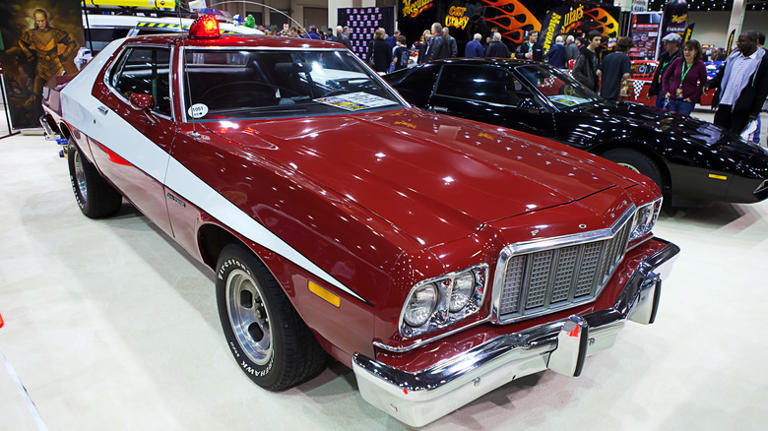
The classic 1974/76 Ford Torino, I was besotted with Starsky & Hutch as a kid and loved the car.
I found online from a few places a little history of the legendary car.
Starsky and Hutch, the fictional undercover cops portrayed in the 1970s TV series of the same name, catapulted the lead actors Paul Michael Glaser and David Soul into the limelight. But it was their on screen ride a bright red Ford Gran Torino with a distinctive white stripe that stole the show, the high-speed, tire-screeching car chases that punctuated every storyline made the car as famous as the show and the actors themselves. This eye-catching two-door hardtop, with its five-slot mags and pumped-up rear suspension, quickly became a pop culture icon, with vehicles from the show highly sought after today.
The success of the show, which ran for 93 episodes from 1975 to 1979, inspired a string of similarly themed buddy-cop TV shows. “ChiPs” motorcycle officers Baker and Ponch, and “Miami Vice” detectives Crockett and Tubbs, quickly followed in its tire tracks along. Perhaps the other car with such notoriety was with the those Duke boys Bo and Luke jumping, cop evading “The Dukes of Hazzard” in their iconic 1969 Dodge Challenger, the “General Lee”.
When the first series of “Starsky and Hutch” hit the airwaves on America’s ABC, the phone lines of Beverly Hills producers Spelling-Goldberg ran hot, with viewers eager to know where they could purchase such a car. Sensing an opportunity to make money, the clever marketing gurus at Ford rushed to release a limited edition run of just over 1300 lookalikes for the 1976 model year. The existence of these factory replicas along with a fleet of home-built tribute cars that makes it difficult to authenticate any Gran Torino purportedly used in the series.
A red ‘Starsky and Hutch’ style Ford Torino on display at a show.
Ford supplied half a dozen or so 1974-76 Torinos for the TV series, but only three are known to have survived. Stunt cars got V8s of either 400 or 460 ci, and for better acceleration in the signature chase scenes, a few of these were modified with lower ratio gears which had a “Do Not Exceed 50 mph” label on the dash to prevent extreme redline and damaging the engines..
During documentary in 2003 called: “Starsky and Hutch: Making Of Behind The Badge,” the TV series creator William Blinn revealed he originally envisioned the duo driving a green Chevy Camaro convertible, but the producers already had a deal with Ford to supply cars. “My heart broke,” Blinn recalls, “until the guy showed up in the red and white Torino.” The transportation crew had dressed it up like the hottest thing on wheels, he says, when it could hardly get up a steep hill. “Why that car became such a trademark for the show, I truly don’t know,” Blinn muses.
Paul Michael Glaser, who plays the brooding detective Starsky in the series, disliked the car on sight, disparagingly dubbing it “the Striped Tomato.” “I vowed to destroy that car,” Glaser said in the documentary. “Whenever there was an opportunity to hit something, I’d try to hit it.” Despite his heroic efforts to wreck the car, Glaser never managed to do so with the string of replacements ready. Paul continued his disdain for the ‘Striped Tomato’ which failed to diminish its enduring desirability, with one of the show’s on set Torinos fetching a respectable $40,000 at auction in 2014.
Known on the set as Torino #1 and Torino #2, the “Starsky and Hutch” daily drivers had 351 Windsor blocks and auto transmissions. Sadly the gorgeous sounds of the sporty engine and manual gear shifts were added into the show post production. The two cars are distinguishable by their front seats, with car #2 receiving the upgrade from bench to buckets. These “hero cars” were given a hard time during the extensive filming schedules by being jumped on, raced, driven hard, burning through endless amounts of tyres and Paul Glaser driving into trash cans and anything else he could find at the time of shooting. After filming had finished the show’s Torinos were auctioned off by Ford.
Those Torinos have passed through the hands of fans and collectors alike, with each eventually being lovingly restored to its prime-time condition. Some twenty-five years later, the continued success of the 70’s TV series inspired a big screen remake, with Ben Stiller and Owen Wilson in the lead roles Starsky and Hutch. At the British premiere, Torino #2 rolled out on the red carpet alongside original actors Paul Michael Glaser, David Soul, and Antonio Fargas — who played their streetwise confidante, Huggy Bear.
Actors David Soul (Hutch), Paul Michael Glaser (Starsky), and Antonio Fargas (Huggy Bear) from the TV series ‘Starsky & Hutch’ pose on the bonnet of a Ford Torino at the premiere of the 2004 movie remake.
Torino #1 was displayed at The Petersen Automotive Museum in Los Angeles as recently as 2023, with parts of the car autographed by stars and crew from the series. Another car from the 1970s TV series can be seen at The Auto Collections in Las Vegas. Not many cars have made me ‘star struck’, but this car did from the age of nine when I was allowed top stay up and watch the program it if I was good, which always worked. Even today this car still has a menacing road presence and still looks amazing.
The entrance to the show ground was now to be come the exit, with a single lane dirt track out. The car boot show had all but wrapped up so there wouldn’t be the delays getting out. With that all taken into consideration I still left an hour early to make sure I missed any leaving antics. The trip home was relaxed, but the clouds were starting to look very dark and grey, I needn’t have worried as it didn’t come to anything.
A good selection of cars again, but they really do need to sort out the entrance to these events.
This car show is held at the oldest event that I attend. The castle itself is located in Essex and was built in the year 1140 by Aubrey II. There are many event types hosted here such as jousting, weddings, holidays, outdoor cinema, concerts etc. the one I’m most interested in is the annual car show. This year the sun was out and due to stay out all day. The event is held approx. thirty miles away from me and would take forty seven minutes to get there, mainly due to the minor roads and a town to navigate through. The gates open to the public at eleven, so all participants had to arrive by ten fifteen and be parked up by ten forty five. IT was a car show day and I was going to get a lay-in on a Sunday, win win for me! A really relaxing for two thirds of the drive until I got to Sudbury where a complete idiot, (which wasn’t what I called him), decided that he wanted to turn right after being in the left hand only lane. He chopped across the front of me so hard I had to brake hard and swerve out of the way. Obviously he knew I would back out the way as I wouldn’t want to damage my car. So if you are the driver of the red Mazda CX-5 who chopped in front of me with a car full of kids who might be reading this, may I suggest you take a couple of refresher driving lessons, or please come and find me at a car show where I might accept your apology and discuss your total disregard for other road users. I just seem to attract these morons for some reason. Anyway, the last part of the journey was around some winding country roads with some amazing views. I even had a classic Jaguar behind me, who left plenty of space between us and seemed to be enjoying his drive too.
I pulled into the venue and was told where my parking allocation would be at the ‘lake’ area.
The field was filling up and lots of cars were already in their lines. I gave the car the mandatory wipe over and started my walk up and down the field.
Some beautiful Corvettes were parked in the line I was in.
Where I was parked us were two Mustangs right behind me.
A real soft spot of mine is the beautiful Thunderbird, which was for sale.
I still crave these Audi Quattro, my modern day classic choice.
The Lotus stand was well represented.
I had now completed the field and started to walk up the slight hill towards the castle and the next display of cars.
At the top was the little bridge to get to the castle and the field. There was the usual food and drink stalls along with a three piece band to add a little light entertainment.
This field was mainly club stands with newish cars from MG which I didn’t take that many photo’s of. But the other privateers were worth the time to look around.
I walked back to the car for a well earned sit down in the chair and slap on some factor fifty sunscreen. My mate Craig had caught up with me and joined me for a sit down and chat. I was so hot sitting by the back of my car, we moved to the line of trees for some shade and discussed cars from the show.
My car of the show was this rather nice 1959 El Camino, I think its the rear fins that did it for me.
The show was due to close at four, about half an hour before that the cars started to leave. I decided that as it was hot I would join them for the journey home. The journey was amazing and there was hardly anybody on the roads near me which means I could just meander my way home unstressed.
A great day out again and a welcome return back to Hedingham Castle.